
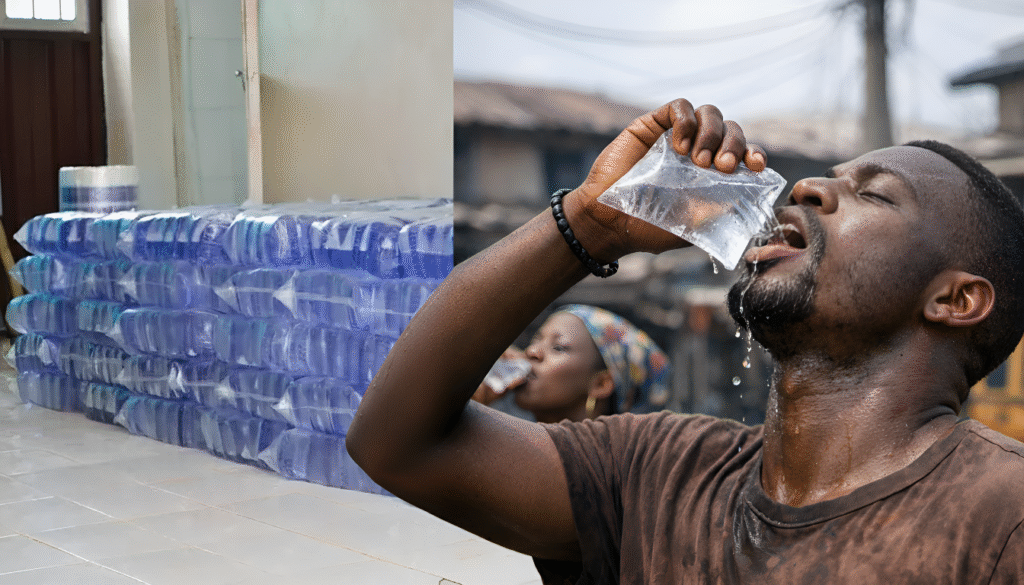
Nigeria is consuming over 2.5 billion litres of sachet water annually, and this has helped bridge gaps in access to drinking water, resulting in severe environmental consequences like blocked drainage systems, flooding, degradation of ecosystems, and risks to public health and biodiversity.
Besides,research has proven that chemicals used in the production of the nylon sachet packaging leech into the water and, when consumed, affect various organs of the human body. ‘Pure Water’, ridden with chemicals and nano plastics, implicated in plastic pollution, is anything but pure!

Speaking at the meeting for the project held in Abuja, the Director General of the National Environmental Standards and Regulations Enforcement Agency, NESREA, Prof Innocent Barikor described it as timely, saying, “it would move on to revolutionize water packaging to reduce sachet consumption in the country."

“The GEF-ID 11193, Integrated Child Project represents a strategic and transformative intervention. It aligns with Priority 4 of Presidential Key Areas of Priority which demonstrates the determination of Mr. President  to promote environmental sustainability in the country."

According to Barikor, it is also in line with the NESREA’s mandate to protect and preserve our environment for present and future generations. In Nigeria, it goes by the street name, ‘pure water’- very available, very affordable and the quick choice for many at home, in the public places, wherever the need to quench one’s thirst.

The Direction General further explained, this seemingly simple mean that hydration solution comes with grave consequences for human and environmental health.

"A 5-Year Plastic Reboot Nigeria programme hinges on the Reduction of problematic and unnecessary single-use plastics in the food and beverage sector, implementation of policies and innovative business models that ensure material circulation, and Designing for Circularity.

The Project, implemented by the United Nations Environment Programme (UNEP) with the support of the Global Environment Facility (GEF) under the Global Plastic Reboot Programme, seeks to reduce the consumption of single use water sachet in Nigeria."

He added, "We need to protect citizens from the dangers of sachet water consumption while providing sustainable alternatives to drinking water, is executing the Plastic Reboot Nigeria programme on  "Circular Solutions to Plastic Pollution in Nigeria".


Also ,Isabelle Vanderbeck of UNEP argued that with the project, Nigeria is unfolding an ambitious plan, which  described as a great milestone in tackling plastic pollution, explaining that the programme intends to prove that it is indeed possible to live without plastic.

Isabelle, made a call to action on the project implementation and emphasized that building societal partnerships will make it to work towards replacing plastics and achieving circularity, through sustainable system transformation.

Contributing ,Evelyn Swain, the Senior Environmental Specialist and lead of the GEF-8 Plastics Integrated Programme (Plastic Reboot) at the GEF, explained that the upstream and midstream levels of plastic production  are key in any successful remodeling of the sector.

“Transforming the sachet water sector in Nigeria will require concrete action from producers and distributors, applying innovative eco-design, reuse models and extended producer responsibility EPR  models,” she added.

Stakeholders for the project were drawn from key governmental and non governmental organisations including the federal Ministry of Environment, the Federal Ministry of Water Resources and Sanitation, National Agency for Food Drug Administration and Control (NAFDAC), Standards Organisation of Nigeria (SON).

Others are: Abuja Environmental Protection Board (AEPB), Association of Table Water Producers , Sustainable Research and Action for Environmental Development (SRADeV), FCT Water Board, Nigeria Bureau of Statistics, HydroPower Area Development Commission  (HYPERDEC), National Plastic Action Partnership (NPAP), and the academia,

 From Cornelius Essen, Abuja.